
There is an assumption buried deep in the operating logic of many organisations. It rarely gets stated explicitly. It is almost never written into a policy document or debated in a leadership meeting. But it shapes how jobs are built, how standards are set, how errors are explained, and how people are treated when they struggle.
The assumption goes like this: if someone has done it once, everyone can do it — every time, under any condition.
It sounds almost reasonable when stated plainly. Of course there is a baseline of capability required for any role. Of course performance standards need to exist. But watch what this assumption quietly produces in practice, and it becomes much harder to defend.
It produces jobs designed around the best performance of the best person on their best day — and then treats that as the expected standard for everyone, always. It produces procedures written by experts who have long since forgotten what it felt like not to know the work. It produces workloads calibrated to what is possible under ideal conditions, then deployed under conditions that are never ideal. And when people struggle — when the errors creep in, when the fatigue sets in, when engagement quietly drains away — the assumption produces one final, damaging conclusion: the problem is with the person.
The problem is almost never with the person.
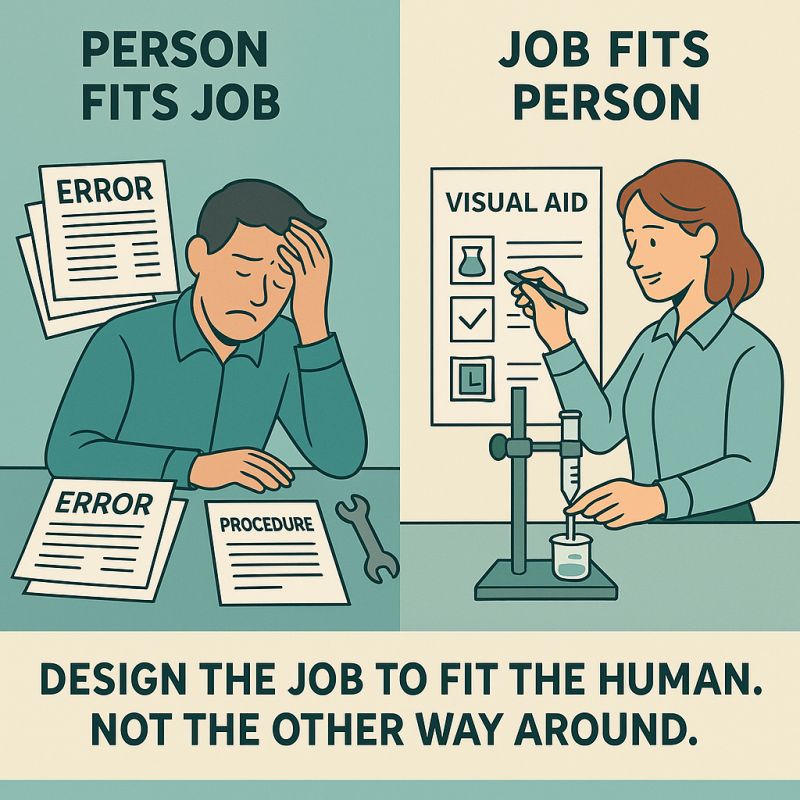
The Two Paths of Work Design
Every role in every organisation sits somewhere on a spectrum between two fundamentally different design philosophies. Understanding where your roles sit — and which direction they are oriented — is one of the most practically important questions a leader, quality professional, or systems designer can ask.
Path One: The Job Fits the Person
In person-centred work design, the starting point is the human being who will perform the work. What are the natural ranges of human capability in the relevant dimensions — physical reach, cognitive load tolerance, memory reliability, attentional endurance, sensory acuity, biomechanical comfort? How do those capabilities vary across a realistic population of workers, not just a theoretical average? What conditions sustain reliable performance, and what conditions degrade it?
From those answers, the work is designed. Tasks are shaped around what humans can comfortably and sustainably do. Tools are selected or engineered to fit the range of people who will use them. Procedures are written in formats that match how human beings actually process and retain information. Workloads are set at levels that allow consistent performance across a shift, a week, a career — not just in a snapshot performance during ideal conditions.
The goal is not to make work effortless or unchallenging. The goal is to ensure that performing the work correctly does not require a person to compensate for a design that was never built with them in mind.
Path Two: The Person Fits the Job
In task-centred work design, the starting point is the task itself. Here is what needs to be accomplished. Here is the sequence of steps, the speed of execution, the physical configuration of the workstation, the format of the documentation, the volume of simultaneous demands. The role is defined. The person is expected to fit it.
This approach is not necessarily malicious or thoughtless. It often emerges from entirely legitimate considerations — engineering constraints, regulatory requirements, operational necessity, resource limitations. But when it becomes the default philosophy — when the answer to “this role is producing a lot of errors” is always “we need a better person in this role” rather than “we need a better design for this role” — it becomes a serious organisational liability.
Task-centred design places the burden of compensation on the individual. It asks people to stretch, adapt, and persevere. For a while, capable and committed people do exactly that. But stretching and adapting and persevering is not a steady state. It is a drain on a finite resource. And what task-centred design reliably produces, over time, is fatigue, error, disengagement, and eventually — in regulated and high-stakes environments — compliance risk.
The Flawed Assumption and Its Consequences
Return to the assumption: if anyone has done it once, everyone can do it — every time, under any condition.
This assumption fails on every dimension it makes a claim about.
“If anyone has done it…” Peak performance by one individual, in one instance, under one set of conditions, tells us very little about what is sustainably achievable across a population of workers across the full range of operational conditions. Elite performers exist in every field, and their performance is genuinely impressive — but building a system’s baseline expectations around outlier performance is a design error of the first order. It is the equivalent of designing a doorway based on the height of the tallest person who might walk through it and then being confused when everyone else has to duck.
“…everyone can do it…” Human beings vary. This is not a controversial statement. They vary in physical dimensions — height, reach, grip strength, laterality. They vary in cognitive profile — processing speed, working memory capacity, reading style, spatial reasoning, verbal versus visual information processing. They vary in sensory acuity, in communication preferences, in the conditions under which their performance is most reliable. A job designed around one profile of human capability will not fit everyone who holds that job — and the mismatch, wherever it occurs, is a source of error risk that no amount of training or motivation can fully compensate for.
“…every time…” Even the same person performing the same task does not produce identical results across all repetitions. Human performance varies with time of day, accumulated fatigue, emotional state, workload history, physical health, and dozens of other factors that no role description accounts for. The assumption that trained competence produces consistent performance independent of condition is contradicted by every serious study of human performance ever conducted.
“…under any condition.” Perhaps the most dangerous clause. This is the assumption that underlies the design of roles that are reasonable in calm, well-resourced, fully-staffed conditions — and then deployed unchanged in the real world of shift handover gaps, equipment outages, simultaneous competing demands, interruptions, and time pressure. Conditions are almost never static. A role that fits a person under ideal conditions may become a role that exceeds sustainable human limits under the conditions that actually occur on a Thursday afternoon at the end of a twelve-hour shift.
Two Stories That Change How You See This
Abstract principles become real in the specific. Here are two cases that illustrate exactly what person-centred design looks like in practice — and what it costs when it is absent.
The Left-Handed Analyst
A QC analyst was consistently struggling. Her analytical results were variable. Her performance against established standards was below expectation. The natural organisational response — the task-centred response — would have been to identify a capability gap, prescribe more training, and document the performance concern.
The actual problem had nothing to do with her capability.
Her workstation had been set up for right-handed operation. The dominant hand would reach right. The instrument controls were positioned right. The documentation surface was arranged right. For a right-handed analyst, this created no friction — the workflow mapped naturally onto motor habit and physical comfort. For her, a left-hander, every action required a small but real compensation. She was reaching across her body. She was operating instruments from the non-dominant side. She was writing at an angle that produced discomfort. She was spending cognitive and physical resource on compensating for a workspace mismatch — resource that should have been available for the analytical work itself.
The adjustments required were not extensive. The workstation was reconfigured. Controls were repositioned. The documentation surface was moved. And the analyst — who had been struggling, who might have been labelled a performance concern, who might have been managed out of a role she was entirely capable of performing — demonstrated the competence she had always possessed, in conditions that finally supported rather than undermined it.
The lesson here is not just about left-handers. It is about the general principle that physical workspace design encodes assumptions about who will use it. When those assumptions are wrong for a specific individual, that individual pays a performance penalty every single day — a penalty that is entirely the product of a design decision made before they ever walked into the room.
The Technician Whose Dyslexia Was Treated as a Training Problem
A maintenance technician with mild dyslexia was making procedural errors. Standard operating procedures are dense text documents — numbered steps, technical terminology, complex conditional logic. For the majority of the workforce, this format is workable. For someone whose cognitive profile makes processing dense linear text effortful, it is a daily obstacle course.
The initial response was more training. Multiple rounds of retraining on the same text-heavy SOPs. The same information delivered again, in the same format, to a person whose difficulty was never with the information — it was with the format in which the information was being delivered.
The retraining did not work. This should not have been surprising. If a tool doesn’t fit the person using it, using it more often does not make it fit better.
The intervention that worked was to rewrite the relevant SOPs using visual formats. Process flow diagrams. Illustrated step sequences. Colour-coded decision points. Photographs of equipment in the correct and incorrect configuration. Information that could be absorbed through visual pattern recognition rather than sequential text decoding.
The procedural errors stopped. Not because the technician learned something new. Because the format of the information was changed to align with how he actually processed information most reliably.
Consider what had been happening in the period between the errors beginning and the format change being made. The organisation was experiencing real procedural deviations with real operational consequences. It was investing repeated training resource in an intervention that the evidence was clearly showing was not working. The technician was experiencing repeated “failure” in a task that the organisation kept framing as a performance deficit — when it was an information design deficit. The cost was being paid in errors, in resource, and in the experience of an individual who was capable of performing his role reliably and could not do so through no fault of his own.
Burnout Is a Design Outcome, Not a Personal Failure
It is worth pausing on burnout specifically, because it is increasingly discussed in organisational contexts in ways that are well-intentioned but fundamentally misdirected.
Burnout has been framed as an individual resilience problem. A mental health problem. A work-life balance problem. It has generated an enormous industry of individual-level interventions — mindfulness programmes, resilience training, wellbeing apps, counselling access, “self-care” campaigns. All of these may have some value at the margin. None of them address the actual cause of burnout, which is this: a sustained mismatch between what a role demands and what a human being can sustainably provide.
Christina Maslach, whose research on burnout is foundational, identified six key areas of work-life mismatch that drive burnout: workload, control, reward, community, fairness, and values. Every one of those six dimensions is a design variable. Every one of them can be adjusted by how work is structured, resourced, managed, and supported. None of them is primarily a function of individual resilience.
When workloads are chronically set above sustainable human limits — because the assumption is that if someone managed it once, everyone should manage it always — burnout is not a risk. It is a planned outcome. The design guarantees it.
Person-centred work design is not soft. It is not a concession to weakness. It is a recognition that sustainable performance — the kind that can be relied upon shift after shift, year after year, in the variable conditions of real operations — requires designing work for the humans who will actually perform it, not for the theoretical optimal performer working under theoretical optimal conditions.
The Compliance Dimension
In regulated industries, there is an additional layer to this argument that deserves explicit attention.
Regulatory frameworks — in pharmaceuticals, food safety, medical devices, aviation, nuclear, and many other sectors — require consistency, traceability, and reliability. They require that procedures be followed, that results be reproducible, that deviations be documented and investigated. They build their assurance models on the assumption that if a process is well-designed and correctly followed, outcomes will be reliably consistent.
But that assurance model has a critical dependency: the process must be designed such that correctly following it is achievable under the range of conditions in which it will actually be performed, by the range of people who will actually perform it.
When work is task-centred and poorly designed for human performance, compliance failures are not random. They are predictable. They cluster around the points where the human capability requirement exceeds what the human population can reliably deliver. They cluster in roles that are physically demanding beyond sustainable limits. In procedures that are cognitively inaccessible to a significant portion of the workforce. In workloads that guarantee attentional degradation by the end of the shift.
Regulators are increasingly aware of this. The concept of human factors — the systematic application of knowledge about human performance, limitations, and capabilities to the design of systems, tasks, and environments — is now explicitly referenced in regulatory guidance across multiple sectors. It is no longer adequate, in serious regulatory frameworks, to respond to a pattern of compliance failures with repeated retraining of the same people in the same format with the same expectations.
The question that a mature regulatory response, and a mature quality culture, increasingly asks is: what in the design of this work made this error likely?
What Person-Centred Design Actually Requires
Shifting from task-centred to person-centred work design is not a single action. It is a design orientation — a set of habits and practices applied across the lifecycle of how work is structured and maintained.
In job design: Start with a realistic assessment of the population who will perform the work. Not the ideal candidate. The range of people who will actually hold this role, with the variation in physical profile, cognitive style, experience level, and background that a real workforce represents. Design tasks to be performable — reliably, consistently, sustainably — across that range.
In workspace and equipment design: Apply ergonomic principles not as a compliance checkbox but as a performance investment. A workstation that fits the worker produces fewer errors, less fatigue, and more reliable output than a workstation that forces the worker to compensate for its design every shift.
In procedure writing: Ask not only “is this technically accurate?” but “is this accessible to the person who will use it, in the conditions they will use it, at the point in their shift when they will need it?” Consider format as seriously as content. Text, visuals, colour-coding, layout, decision points, memory aids — these are not decorative. They are functional design choices with real performance consequences.
In workload setting: Calibrate not to peak performance under ideal conditions but to sustainable performance across the realistic range of operational conditions. If the role is performable at that workload only when fully staffed, fully rested, and free of interference — and those conditions do not consistently hold — the workload is not sustainably designed.
In response to errors: When errors occur, ask first about design conditions before drawing conclusions about individual performance. Is this a pattern? Does it cluster around particular tasks, particular times, particular conditions, particular configurations? Patterns are the fingerprint of design problems masquerading as individual failures.
Conclusion: Designing for the Human Behind the Role
The left-handed analyst. The technician whose dyslexia made text-heavy SOPs inaccessible. These are not exceptional cases requiring extraordinary accommodation. They are examples of what happens when organisations pay attention to the specific human performing the work, rather than the abstract role description the work was designed around.
They are also examples of what becomes possible when the design is changed. Not capability development programmes. Not performance management processes. Not more retraining of the same material in the same format. A workspace repositioned. A document reformatted. And in both cases, a person performing reliably in a role they were entirely capable of filling — once the role was designed to fit them.
The best systems do not push people harder. They make it easier to do the work correctly. They reduce the gap between the natural path of human action and the path that produces the right outcome. They treat human variability not as a nuisance to be overcome but as a design parameter to be accommodated.
When jobs are designed to fit the person, errors fall. Fatigue falls. Disengagement falls. Compliance improves. And the people doing the work — the people who come in every day, who care about doing it right, who are not failing because they lack commitment or capability but because they are working in systems that were never designed with them in mind — can finally demonstrate what they are actually capable of.
That is what person-centred design delivers.
That is what the alternative consistently fails to.
The framework of person-centred versus task-centred design draws on decades of human factors research and the practical application of ergonomic and cognitive engineering principles in regulated and high-risk industries. The principle that system design, not individual deficiency, is the primary driver of human error performance is foundational to this field.